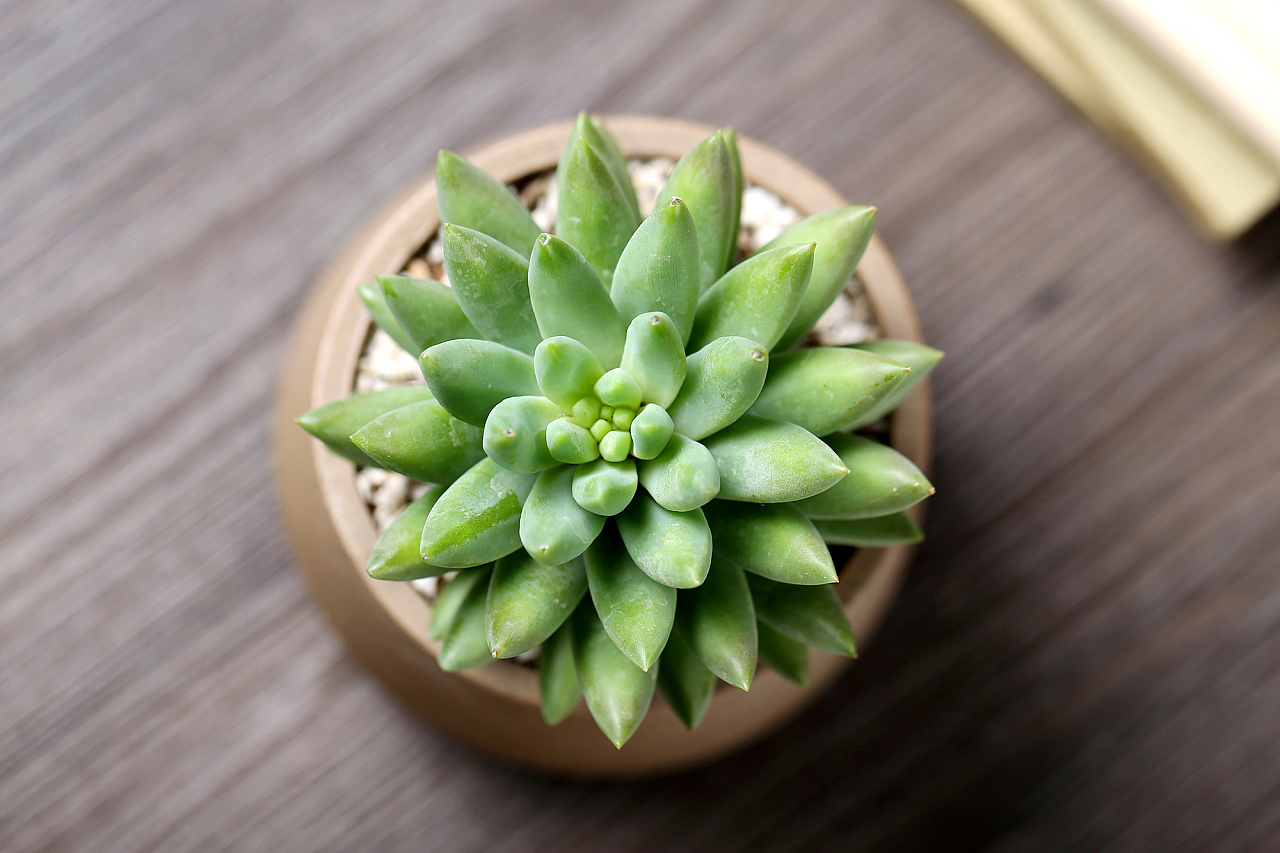
Succulent plants are also called succulent plants and succulent plants. Succulent plants can absorb carbon dioxide, release oxygen, purify air, absorb radiation and so on. There are more than ten thousand kinds of succulent plants. The most common succulent plants are aloe vera, Sedum, yinnvxin, angel's tears, Jixing Meiren, Yulu, Mingyue, shengshihua, hongzhiyu, etc.
1. Pot requirements:
The pottery pot has good water absorption, and the problem of watering too much is not big, which can alleviate the negative effect caused by excessive watering. However, the weight of the pot increases after absorbing water, which requires the flower shelf to be strong. The air permeability of purple sand basin is between tile basin and porcelain basin. Purple sand basin need to pay special attention to the thickness of the basin wall, the thinner the purple sand basin, the stronger the air permeability. The thicker the basin wall, the better the air permeability is.
2. Soil requirements:
For succulent plants, most of the cultivated soil sold on the market has certain limitations, so experienced enthusiasts usually prepare them by themselves. What kind of culture soil is considered as high quality? In short, it should be a sandy loam with loose air permeability, good drainage, a certain granular structure, and can provide nutrients for plant growth. When preparing, pay attention to the reasonable combination of organic and inorganic plant materials to avoid too fine and small dust.
Here are some common substrates for succulent plants:
1. Organic plant material
① Rotten leaf soil: the Clivia soil sold on the market can be selected, and the leaves of Taxodium or Zelkova schneideriana can be collected for composting and fermentation, and disinfected when used.
② Peat: buried in the ground for thousands of years of Lake plants, Jilin, Heilongjiang production is better. High quality peat is brown in color, high in organic matter content, good in fiber, loose in texture, non sticky in hand, strong in adsorption, and slightly acidic in pH value.
③ Sawdust: it has strong water permeability and water retention, but it is not used alone because of its high carbon content and low nitrogen content. It can be mixed with some nitrogen-containing compounds such as soybean cake for fermentation.
2. Inorganic plant material
① Vermiculite: a kind of honeycomb like structure of gold light material, water retention, heat preservation, good ventilation and no bacteria. The survival rate of cutting substrate is high, but it has no fertility, so it should be mixed with other substrates. It is easy to destroy its structure after long-term cultivation. Used vermiculite should be screened before use.
② Perlite: a volcanic rock containing aluminosilicate that is heated and expanded at high temperatures to form a lightweight material. Good water permeability and good ventilation. But the effective water content is low, so it is often used as supplementary material.
③ Coconut bran: palm fiber, loose texture, especially strong water retention. It is often used for cutting. The coconut bran, also known as "expansive soil", is commonly seen in the market. Soak it with water first.
3. Succulent plants themselves are basically made of water. Plants that store their own water can survive without much watering. On the contrary, if too much water is supplied, too much water will be stored, which will cause rot and wither slowly. Therefore, when watering each time, we should pay attention to observe the state of plants. If the plant becomes thin and shriveled, this is the appearance that needs water, if the water is enough, then it looks plump. This is a simple distinction.
Succulent plants must timely supplement water for growth and development, rather than "dry rather than wet" as some people think. Of course, for plants planted in the ground, watering times can be less. For most succulent plants and cactus cultivated by their own roots, watering is difficult to master, mainly in the timeliness of watering.
The best time to water succulent plants is in the early morning of summer. In winter, it should be done before noon in sunny weather, and it can be done in spring and autumn. In general, do not pour water from the top, otherwise there will be unsightly spots on the sphere over time. The hairs of pilar species are easy to be polluted and bonded, and the ponding at the growth points such as cuihuazhang will cause rot. Pond water on the plants easy to grow algae, as if growing moss is very ugly. In general, the watering must be sufficient, so that the soil must be loosened frequently so that the basin soil can absorb enough water evenly. For the growing winter type and intermediate type plants, the basin soil should be kept moist without ponding, and the water should be completely dry, neither ponding nor too dry. The summer type can be watered properly, but not too much. In case of rainy days or sudden temperature drop, stop watering.
4. It is also very important to know how much sunlight is placed in the place. Not only succulent plants, but all plants can't survive where there is no light at all. Without light, plants will grow like bean sprouts, weak and weak, and the color of leaves will fade. If you want them to keep healthy and good posture, you must be able to give them the most appropriate sunshine. Lighting can't replace sunlight, which needs to be noted.
Within a year, most of the species grow faster in spring. When the temperature rises, the root activity of plants becomes faster and the soil in the basin dries faster. Therefore, it is necessary to actively supplement water, and the surface can be watered thoroughly after the surface is dry.
Plants that have been stuffy in the room in winter can also be moved outdoors in this season to enjoy the caress of sunlight and wind. However, at this time, the sun is getting stronger, and it is easy to get sunburnt if you suddenly take it outside. You can choose to take it out on cloudy days, or cover it with a newspaper when you take it out on a sunny day, and then take it off when the plants adapt to the light. On the day of cold wave and frost, it is better to put it indoors at night.
5. Summer is a difficult season for succulent plants. In this period, the humidity is higher, the moisture in the air is more, and the succulent plants can survive by relying on the moisture in the air alone. Watering can be controlled. But if the plant size is too small, three months without water will also dry up, so you can judge by the condition of the leaves, choose to supplement water in the cool night.
Please do not put more meat in airtight room. If the room has air conditioning, the problem is not big, but the air conditioning will also increase the pressure on the plants, try not to place it directly to the air conditioning outlet.
It is very important for succulent plants to maintain certain air humidity during their growth period. When the plant enters the growth period, the effect of air humidity is obvious. Species native to tropical rainforests are more stringent. Some horticultural varieties with rich color change will be more colorful if they can maintain a certain air humidity. It can be said that most varieties need a certain humidity at this time. But in the dormancy period, the air humidity should be very cautious. The first thing to do is some varieties with higher meat quality.
For example, summer in Shanghai is a typical "hot and humid" weather. The highly fleshy fruits of the family Amygdalus are quite perishable. How to spend the summer in the old varieties of raw stone flower and Emperor jade is often the most headache for lovers. In the same way, dormant winter varieties should also maintain a certain degree of dryness. This point should be paid more attention when the temperature is lower than 5 ℃. When the temperature continues to drop to 0 degrees or less. At this point, if the humidity is high, it is often fatal and can be fatal overnight. But most cities in the north are drier in winter. This kind of "wet and cold" climate is common in some southern cities in China
6. People have the impression that succulent plants are not resistant to cold and are not easy to survive the winter. In order to prevent frost when the temperature is low, reduce the frequency of watering. After less water, the concentration of succulent plants becomes higher and it is not easy to freeze. As in summer, control watering. In particular, the cold resistant varieties can not be watered at all.
The leaves of Hardy varieties will fall off, stop growing completely and go into dormancy. These varieties can completely cut off water until spring and wait for the new buds to revive. Must indoor winter, put in the window with light, sunshine as far as possible. At night, plants should be placed a little far away from the window to prevent freezing.
The optimum temperature for succulent plants is 15 ~ 28 ℃, and the tolerance limit is 5 ~ 35 ℃. Many succulent plants sold on the market are not hardy. Although some agave and Sedum can tolerate a slight frost, they are not. The lowest temperature we give plants throughout the year is 55 degrees Fahrenheit (about 12 degrees Celsius), and some sensitive varieties maintain above 60 degrees Fahrenheit (15 degrees Celsius). The highest temperature depends on the weather, and most of the meat is well adapted to temperatures of 100 degrees Fahrenheit (38C). The long-term heat, at best, keeps them dormant.
Of course, too high temperature will damage the plant, especially for the greenhouse and other full sunlight breeding environment, at this time, good air circulation is very necessary. Hot, still air can quickly kill flesh.
7. It is necessary for succulent plants to provide a certain amount of nutrition during the growing season, then gradually reduce the nutrient supply, and do not apply fertilizer when it is dormant. General winter type succulent plant varieties and intermediate type plants are applied with thin liquid fertilizer or compound fertilizer once every 20 days. Fertilization time can be in the sunny morning, and pay attention not to splash fertilizer on the plant. In summer, fertilization is not necessary.
8. For many succulent plants, they can be propagated by cutting branches and cuttings from the stems with sharp knives. Any tool used for cutting plants should be disinfected with alcohol in advance. It is suitable to cut the head in the middle of April every year. Leave three or four leaves under it. Then air the cut leaves for five days before cutting.
Sowing and cutting propagation of succulent plants
1. Sowing: the advantage is that a large number of seedlings can be obtained at one time. In succulent plants, except for a few species that can self pollinate, most belong to insect or bird borne flowers, and the method of artificial pollination must be adopted to bear fruit. The seed life of succulent plants is short. For example, the seed life of GUANGTANG is only a few weeks. The germination rate of seeds of succulent plants will decrease rapidly when stored at room temperature for one year. For this reason, many succulent plants are sown when their seeds are ripe or stored in the following spring. Different families and genera also have different germination time, the early 2 days can germinate, the late 25 days will germinate.
2. Leaf cuttings: often use thick leaves placed on a slightly moist sand bed or loose soil surface, and they will take root very quickly. Adventitious buds will appear at the base of the leaves to form small plants, such as tianzhang, shiliuhua and large leaves.
3. Stem cutting: in the breeding process of succulent plants, combined with pruning and shaping, the branches are cut to be cuttings, such as desert rose, purple dragon horn, tiger thorn plum, Caiyun Pavilion, etc. The desert rose, African overlord tree and Qingfeng, which will shed white milk in the cut section, must be treated with Qianjing, and then cut after a little air drying.
4. Root cutting: for the more valuable varieties of Liliaceae, the roots are very strong and developed. The relatively mature fleshy roots are cut off and buried in the sand bed. The upper part is slightly exposed and kept moist and bright light. New buds can sprout from the top of the roots to form complete small plants.
5. Grafting: in succulent plants, grafting is often used to propagate brocade and other varieties. Such as Bawangbian as rootstock, grafting Chunfeng; Ma Zhilan tree as rootstock, grafting Yale dance; African overlord tree as rootstock, grafting African overlord tree; big flower rhinoceros horn as rootstock, grafting Purple Dragon horn, etc., the ornamental effect is good. But in the process of grafting, because the plant contains white emulsion, the viscosity is large. Therefore, grafting operation should be fast and skillful to achieve success.
6. Ramet: ramet is the easiest and safest way to propagate succulent plants. As long as the succulent plants with rosette leaf cluster or group shape can carry out ramet propagation through their sucking buds, walking stems, bulbs, tubers and small plants, which can be carried out when changing pots in spring. Of course, in succulent plants, the varieties with spotted brocade, such as tiger tailed orchid in Phnom Penh, Leishen brocade in princess, nocturnal brocade and green jade fan brocade, must be propagated by branching to maintain the purity of their varieties.